
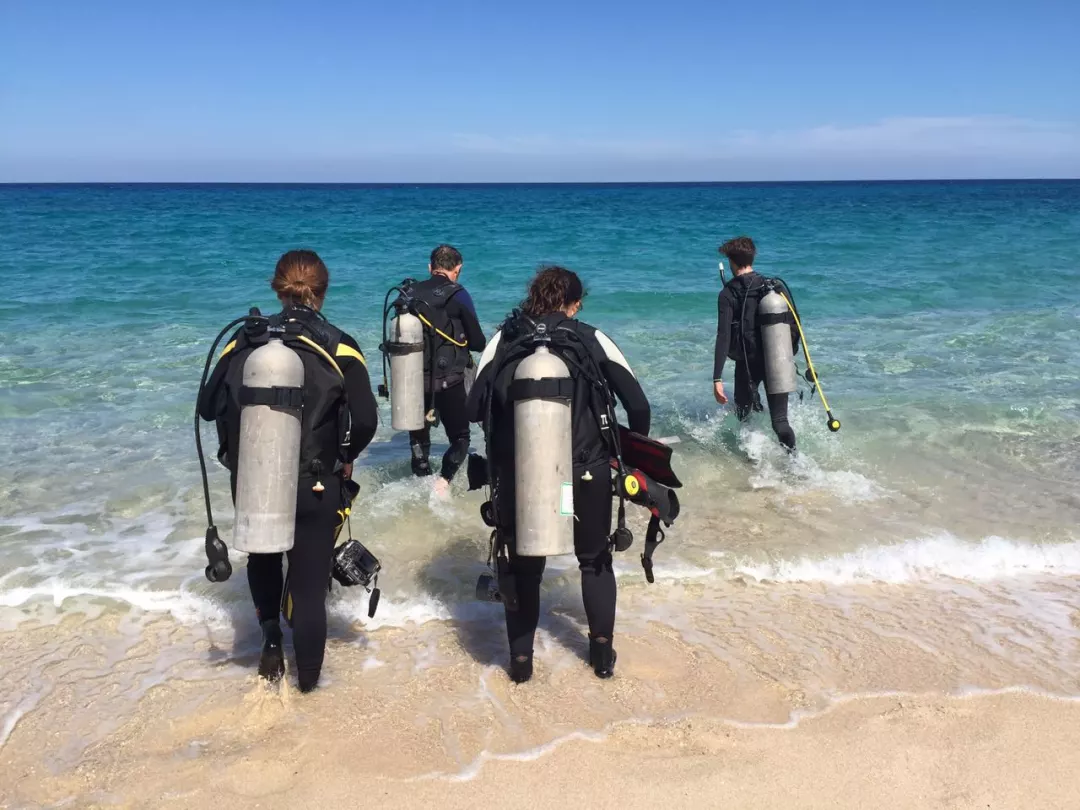

For those looking to make a professional career in diving
If you love diving and teamwork, this course was made for you!
This course will give you the tools and will train you to guide others as they experience the underwater world. The Divemaster course allows you to guide and help divers. If you would like to start your career as a profesional diver, this is the next step.
The PADI Divemaster certification is not just another course; it is your gateway to an underwater leadership career. As a certified dive guide, you will transition from a recreational diver to a respected professional, capable of mentoring others, anticipating risks, and delivering exceptional aquatic experiences. If you are ready to turn your passion into a profession, your mentorship starts in the Sea of Cortez.
Oceanographic Guide and Professional Training Conditions in La Paz
A professional PADI Divemaster must confidently operate in any environment. La Paz offers a complex, dynamic oceanographic canvas to forge your leadership skills.
Visibility, Temperature, and Exposure Planning
You will learn to plan logistics around La Paz’s distinct seasonal shifts. Managing divers in winter (19-22°C) requires acute awareness of thermal stress and exposure suit logistics (5mm minimum), while summer (25-30°C) demands different hydration and sun protection strategies on the boat.
| Season | Period | Water Temp | Suggested Exposure Suit |
| Winter | December – February | 19–22 °C (66–72 °F) | Full 5mm wetsuit |
| Spring | March – May | 20–24 °C (68–75 °F) | 3mm to 5mm wetsuit |
| Summer | June – September | 25–30 °C (77–86 °F) | 3mm wetsuit or shorty |
| Autumn / Fall | October – November | 24–29 °C (75–84 °F) | 3mm wetsuit or rashguard |
Site Dynamics and Environmental Assessment: Your training will ensure you master all local environments. You will learn to guide safely in the protected waters of San Rafaelito, navigate the moderate tidal currents of the El Salvatierra, C-59, and Fang Ming wrecks, and evaluate complex sea states at advanced sites like Los Islotes and the open-ocean seamounts of El Bajo. A true Divemaster knows how to read the water, evaluate currents, and make the ultimate “go/no-go” safety call for the group.
The Divemaster Pedagogical Breakdown
The Divemaster internship demands a radical paradigm shift: your mindset must evolve from “Am I safe?” to “Is my entire group safe?”
Equipment Mastery and Leadership: You will elevate your aquatic skills to “demonstration level,” moving with absolute precision to serve as a role model. The course includes rigorous physical stamina evaluations (timed swims, water treading, tired diver tows, and rescue assessments) to ensure you possess the fitness required for aquatic leadership.
The Three Phases of Guiding: You will master the critical phases of dive management.
BEFORE: Conducting precise environmental evaluations, managing boat equipment, and delivering authoritative, engaging dive briefings.
DURING: Maintaining strict in-water supervision, controlling group positioning, anticipating panic or fatigue, and managing air consumption.
AFTER: Ensuring safe exits, completing headcounts, logging dives, and conducting constructive debriefings.

Certification Itinerary
At MTA, we do not believe in “zero-to-hero” express courses. The Divemaster certification is a serious professional credential.
The 3 to 4 Month Internship: There is no fixed, multi-day itinerary. Our program is a structured, immersive mentorship spanning a full season (3 to 4 months). You will work side-by-side with active Divemasters and Instructors as part of our crew.
Real-World Operations: During this internship, you will continuously practice daily dive center logistics, compressor operations, boat control, customer service, and real-world client management, ensuring that upon certification, you are a highly employable, field-tested professional.
Must have PADI Rescue Diver certification and be at least 18 years old.
You must have 40 logged dives.
CPR and first aid certification within less than 24 months.
PADI Divemaster: Professional Training Map (La Paz)
Interactive guide to the diverse marine environments where you will master dive guiding, risk management, and group control.
El Bajo Seamounts
Open ocean seamounts with moderate to strong currents. You will learn to assess offshore conditions and guide experienced certified divers searching for pelagic fauna.
El Salvatierra Wreck
Artificial reef sunk in 1976. Perfect environment to practice leading wreck dives, managing groups in moderate currents, and interpreting marine life for your clients.
Fang Ming Wreck
A 54-meter sunken ship. Here you will develop advanced skills in organizing deep dive logistics and ensuring maximum safety standards for your diving groups.
C-59 Wreck
This artificial reef requires excellent situational awareness. You will master group positioning and navigation in variable tidal currents.
Los Islotes
Emblematic sea lion colony. Learn to manage group interactions with dynamic wildlife, enforcing environmental protection and diver safety protocols.
San Rafaelito Islet
A protected rocky islet. This is your primary zone for assisting instructors with Open Water students and demonstrating confined water skills at a professional level.
Swanne Reef
A shallow rocky reef. Ideal for organizing underwater naturalist dives, practicing mapping projects, and refining your environmental briefing techniques.
Muelle Fiscal (Operations Point)
Your daily professional hub. You will coordinate boat logistics, supervise equipment loading, and conduct comprehensive dive briefings before departures.
Included
E-learning materials.
PADI International Certification.
Diving equipment.
Lunch on diving days.
Not Included
Alcoholic drinks.
You must bring
Ecofriendly sunscreen.
Bathing suit.
Biodiversity Technical Sheets
A certified dive guide does more than navigate; they curate an unforgettable educational experience. You will learn to interpret marine biology for your clients:
Local Authority and the MTA Differentiator
Mexico Travel Adventure (MTA) sets the benchmark for professional dive training in Baja California Sur.
Mentorship from Marine Biologists: Your tutors are not just PADI Instructors; they are credentialed marine biologists and expert naturalists. You will inherit their profound understanding of the Sea of Cortez ecosystem.
Quality and Standards Policy: MTA operates strictly on a hyper-reduced, premium model (maximum 6 clients per boat). By training in this environment, you will learn the absolute highest standard of personalized customer care, logistical precision, and group control in the diving industry—skills that top-tier dive centers worldwide demand from their Divemasters.
Frequently Asked Questions
What are the requirements to enroll in this course?
You need to meet three key requirements: hold the PADI Advanced Open Water and Rescue Diver certifications (or equivalents), have logged a minimum of 40 dives at the start of the course (and 60 for the final certification), and have a valid CPR and First Aid certificate issued within the last 24 months.
Do I need my own dive equipment?
Although it is not strictly mandatory, it is highly recommended that you use your own complete equipment. As a future professional, you must be intimately familiar with your gear and its maintenance to project the professionalism and confidence expected from a Divemaster.
Do I need to have the Nitrox certification?
No, the PADI Enriched Air Diver (Nitrox) certification is not a requirement to enter the Divemaster course. However, it can be a very useful specialty if you want to work as a Divemaster, especially in destinations where Nitrox is commonly used.